
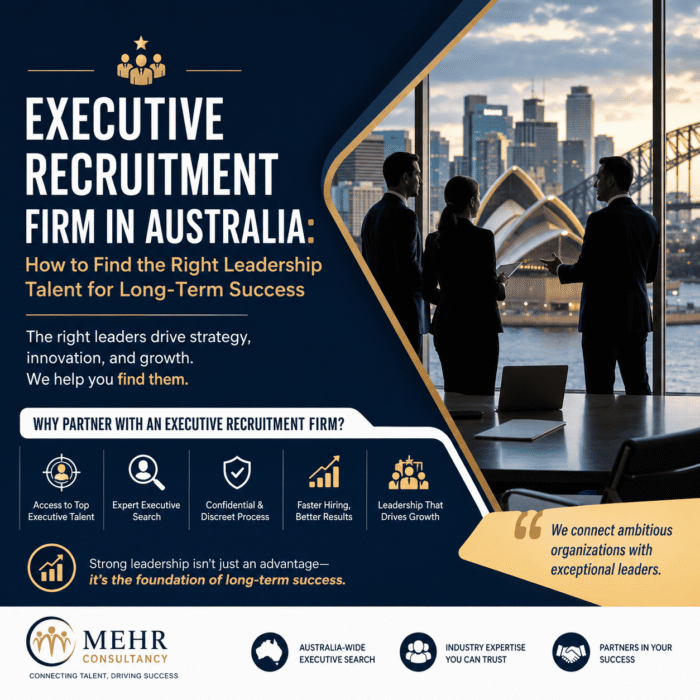
Hiring the right executive can transform an organization. A capable CEO can drive growth, a visionary CTO can accelerate innovation, and an experienced CFO can strengthen financial performance. On the other hand, a poor executive hire can lead to operational challenges, lower employee confidence, and costly turnover. As Australia’s business landscape becomes more competitive, organizations are finding it increasingly difficult to attract experienced leaders through traditional recruitment methods. Many of the best executives are already employed and are not actively searching for new opportunities. This is why businesses increasingly partner with an Executive Recruitment Firm in Australia.
Executive recruitment firms specialize in identifying, assessing, and recruiting senior leadership professionals through strategic executive search. Instead of waiting for applications, they proactively engage qualified executives, helping organizations secure exceptional leadership talent faster and with greater confidence.
Whether you’re hiring a Chief Executive Officer (CEO), Chief Financial Officer (CFO), Chief Technology Officer (CTO), Managing Director, or another senior executive, working with an executive recruitment firm can significantly improve your hiring outcomes.
In this guide, you’ll discover how executive recruitment works, why businesses across Australia rely on executive search firms, and how to choose the right recruitment partner for long-term success.
Table of Contents
- What is an Executive Recruitment Firm?
- Why Executive Recruitment Matters
- Benefits of Partnering with an Executive Recruitment Firm
- Executive Search Process
- Industries Using Executive Recruitment
- Executive Positions Commonly Filled
- Executive Recruitment vs Traditional Recruitment
- How to Choose the Right Executive Recruitment Firm
- Frequently Asked Questions
What is an Executive Recruitment Firm?
An Executive Recruitment Firm in Australia specializes in recruiting senior professionals for leadership and executive positions.
Unlike traditional recruitment agencies, executive search firms use a proactive approach to identify highly qualified candidates, including passive executives who may not be actively looking for a new role.
Executive recruitment typically focuses on positions such as:
- Chief Executive Officer (CEO)
- Chief Financial Officer (CFO)
- Chief Operating Officer (COO)
- Chief Technology Officer (CTO)
- Chief Information Officer (CIO)
- Chief Marketing Officer (CMO)
- Managing Director
- Country Manager
- General Manager
- Operations Director
- Sales Director
- Human Resources Director
- Board Members
These positions require specialized leadership skills, strategic thinking, and extensive industry experience, making executive recruitment a highly focused discipline.
Why Executive Recruitment Matters
Executive hiring is one of the most important decisions an organization can make.
Senior leaders influence nearly every aspect of a business, including:
- Business strategy
- Financial performance
- Company culture
- Innovation
- Customer experience
- Employee engagement
- Long-term growth
A poor executive hire can result in:
- Reduced productivity
- Leadership instability
- Increased employee turnover
- Higher recruitment costs
- Missed business opportunities
An experienced Executive Recruitment Firm in Australia helps reduce these risks through comprehensive candidate evaluation and strategic executive search.
Benefits of Partnering with an Executive Recruitment Firm in Australia
1. Access to Passive Executive Talent
One of the biggest advantages of executive search is access to passive candidates.
Many of Australia’s most successful executives are not actively applying for jobs. Instead, they are approached directly through professional networks and confidential executive search.
Executive recruiters maintain relationships with senior professionals across industries, allowing businesses to reach candidates who would otherwise remain inaccessible.
2. Faster Executive Hiring
Executive vacancies often remain open for several months.
Executive recruitment firms reduce hiring timelines by leveraging:
- Existing executive talent pools
- Industry networks
- Leadership databases
- Talent mapping
- Confidential outreach
This enables organizations to identify qualified candidates more efficiently.
3. Better Leadership Assessment
Executive recruitment goes beyond reviewing resumes.
Professional recruiters assess:
- Leadership capability
- Strategic thinking
- Emotional intelligence
- Decision-making ability
- Change management skills
- Communication style
- Cultural fit
This helps organizations make informed hiring decisions and improve long-term retention.
4. Confidential Executive Search
Many executive appointments require complete confidentiality.
Examples include:
- CEO succession planning
- Leadership restructuring
- Business acquisitions
- Expansion into new markets
- Replacement of existing executives
Executive recruitment firms manage these searches discreetly while protecting both employer and candidate interests.
5. Reduced Hiring Risk
Replacing an executive is expensive and time-consuming.
To reduce hiring risks, executive recruiters conduct:
- Executive interviews
- Leadership assessments
- Background verification
- Reference checks
- Employment validation
- Cultural fit analysis
These steps significantly increase the likelihood of successful executive placements.
How Executive Search Works
Most executive recruitment firms follow a structured search process designed to identify the most suitable leadership candidates.
Step 1: Understand Business Requirements
The recruitment process begins with an in-depth consultation to understand:
- Business objectives
- Organizational culture
- Leadership expectations
- Reporting structure
- Growth plans
- Required skills and experience
A clear understanding of the role helps recruiters identify candidates who align with both business goals and company values.
Step 2: Talent Mapping
Executive recruiters conduct extensive market research to identify potential candidates.
This includes:
- Competitor analysis
- Industry mapping
- Executive databases
- Professional networks
- Leadership referrals
Rather than relying solely on applicants, recruiters build a targeted list of high-performing executives.
Step 3: Executive Outreach
Qualified executives are approached confidentially to discuss the opportunity.
Recruiters evaluate:
- Career aspirations
- Leadership experience
- Industry expertise
- Compensation expectations
- Availability
Only candidates who demonstrate genuine interest and alignment proceed to the next stage.
Read more: Executive Recruitment Agency in Saudi Arabia: How to Hire Top Leadership Talent Faster
Step 4: Candidate Assessment
Executive recruitment firms conduct a comprehensive evaluation that may include:
- Leadership interviews
- Behavioural assessments
- Executive competency reviews
- Reference verification
- Background screening
This ensures only the strongest candidates are presented to the client.
Industries That Rely on Executive Recruitment
Executive recruitment firms support leadership hiring across a wide range of industries in Australia.
Technology
Technology companies recruit experienced executives to lead digital transformation, product innovation, cybersecurity, and AI initiatives.
Common roles include:
- CTO
- CIO
- VP Engineering
- Chief Digital Officer
Healthcare
Healthcare organizations recruit senior leaders to improve patient care, operational efficiency, compliance, and business growth.
Financial Services
Banks, insurance companies, fintech businesses, and investment firms regularly hire executive leaders in finance, governance, compliance, and risk management.
Mining & Resources
Australia’s mining sector relies on experienced executives to oversee large-scale operations, sustainability initiatives, and international expansion.
Construction & Infrastructure
Major infrastructure and construction companies recruit executives with expertise in project delivery, operations, commercial management, and business development.
Manufacturing
Manufacturers hire senior executives to improve operational performance, supply chain management, and international growth.
Retail & E-commerce
Retail businesses seek leaders who can drive customer experience, omnichannel growth, digital transformation, and profitability.
Executive Positions Commonly Filled
An Executive Recruitment Firm in Australia commonly recruits for:
- Chief Executive Officer (CEO)
- Chief Financial Officer (CFO)
- Chief Operating Officer (COO)
- Chief Technology Officer (CTO)
- Chief Information Officer (CIO)
- Chief Marketing Officer (CMO)
- Managing Director
- Country Manager
- General Manager
- Finance Director
- Operations Director
- HR Director
- Commercial Director
- Sales Director
- Board Members
Strengthen Your Recruitment Strategy
If you’re exploring leadership hiring solutions, you may also find these related resources useful:
- Executive Recruitment Agency in Australia – Learn how executive recruitment agencies help businesses hire senior leaders faster.
- Executive Search Consultants Australia – Discover how specialist executive search consultants identify passive leadership talent.
- Recruitment Agency Australia – Understand the broader recruitment landscape and how different hiring models compare.
These related articles help businesses evaluate the best recruitment approach based on leadership requirements, industry, and long-term growth objectives.
Executive Recruitment Firm vs Executive Recruitment Agency
Many businesses use the terms executive recruitment firm and executive recruitment agency interchangeably. While both help organizations hire senior leaders, executive recruitment firms typically offer a more strategic and consultative approach.
Executive Recruitment Firm | Traditional Recruitment Agency |
Specializes in C-suite and executive hiring | Focuses on general recruitment |
Uses executive search methodology | Relies primarily on job advertisements |
Targets passive candidates | Mostly attracts active job seekers |
Conducts leadership assessments | Resume screening and interviews |
Offers market intelligence and talent mapping | Limited market research |
Provides confidential executive search | Less suitable for confidential hiring |
If your organization is hiring a CEO, CFO, CTO, or another senior executive, partnering with an executive recruitment firm can improve both the speed and quality of your hiring process.
How to Choose the Best Executive Recruitment Firm in Australia
Not all executive search firms deliver the same level of expertise. Choosing the right recruitment partner can significantly influence the success of your leadership hire.
1. Look for Industry Expertise
Executive hiring requires a deep understanding of your industry.
Whether you operate in:
- Technology
- Healthcare
- Mining
- Financial Services
- Manufacturing
- Construction
- Retail
- Professional Services
your recruitment partner should understand industry trends, leadership challenges, and the skills required for executive success.
2. Evaluate Their Executive Search Process
A professional executive recruitment firm should follow a structured process that includes:
- Market mapping
- Talent research
- Confidential candidate outreach
- Leadership assessments
- Reference checks
- Executive interviews
- Background verification
A clear recruitment methodology usually leads to better hiring outcomes.
3. Review Their Executive Network
The strongest executive recruiters have built relationships with senior leaders over many years.
Instead of relying only on applicants, they can introduce your business to experienced executives who may not be actively seeking new opportunities.
4. Understand Their Assessment Methods
Leadership hiring should never rely solely on resumes.
Ask how the recruitment firm evaluates:
- Strategic thinking
- Leadership capability
- Cultural alignment
- Communication skills
- Decision-making ability
- Change management experience
These qualities often determine long-term executive success.
5. Ask About Previous Executive Placements
Request examples of successful executive searches.
Important questions include:
- Which industries have you recruited for?
- What executive roles have you filled?
- What is your average time-to-hire?
- What is your placement success rate?
A proven track record provides greater confidence in the firm’s capabilities.
Common Executive Hiring Mistakes
Even experienced organizations can make costly mistakes when recruiting senior leaders.
Hiring Too Quickly
Leadership appointments deserve careful consideration.
Rushing the process often results in poor cultural fit and long-term performance issues.
Prioritizing Experience Over Leadership
An impressive resume does not always translate into effective leadership.
The best executives combine:
- Strategic vision
- Emotional intelligence
- Strong communication
- Commercial awareness
- Team leadership
- Adaptability
Ignoring Company Culture
Even highly experienced executives may struggle if they do not align with your organization’s values, leadership style, and long-term objectives.
Cultural fit should always be part of the executive selection process.
Limiting the Candidate Pool
Advertising a vacancy alone often attracts only active job seekers.
Executive recruitment firms expand your talent pool by approaching qualified passive candidates through targeted executive search.
Skipping Comprehensive Due Diligence
Executive hires have a significant impact on business performance.
Professional recruiters conduct:
- Leadership assessments
- Executive interviews
- Reference checks
- Background screening
- Employment verification
before presenting shortlisted candidates.
Executive Recruitment Trends in Australia
The executive hiring landscape continues to evolve as organizations respond to changing market conditions and workforce expectations.
Increasing Demand for Digital Leaders
Australian businesses continue investing in:
- Artificial Intelligence (AI)
- Digital transformation
- Cybersecurity
- Cloud computing
- Data analytics
This has increased demand for experienced CTOs, CIOs, Chief Digital Officers, and technology executives.
Greater Focus on Leadership Agility
Modern executives are expected to lead through change.
Businesses increasingly seek leaders who can:
- Drive innovation
- Manage hybrid teams
- Lead organizational transformation
- Improve customer experience
- Build resilient business strategies
Executive Diversity is Becoming a Priority
Organizations are placing greater emphasis on building diverse leadership teams.
A wider range of perspectives improves:
- Innovation
- Decision-making
- Employee engagement
- Business performance
Data-Driven Executive Search
Executive recruitment firms now combine human expertise with technology to improve hiring outcomes.
Advanced market intelligence, talent mapping, and data analytics enable recruiters to identify highly qualified executives more efficiently while maintaining a personalized search process.
Why Businesses Choose Executive Recruitment Firms
Organizations across Australia choose executive recruitment firms because they provide:
- Access to passive executive talent
- Faster executive hiring
- Confidential recruitment
- Comprehensive leadership assessment
- Reduced hiring risks
- Better cultural alignment
- Long-term recruitment success
Rather than simply filling vacancies, executive recruitment firms help businesses build leadership teams that drive sustainable growth.
Conclusion
Hiring exceptional leaders is one of the most important investments any organization can make.
An experienced Executive Recruitment Firm in Australia brings more than recruitment expertise—it delivers strategic market insights, access to passive executive talent, confidential search capabilities, and a rigorous assessment process that improves hiring quality.
Whether you’re recruiting a CEO, CFO, CTO, Managing Director, or another senior executive, partnering with the right executive search firm helps your business secure leaders who can deliver long-term growth and competitive advantage.
Ready to Hire Exceptional Executive Talent?
Finding the right executive shouldn’t rely on luck.
At Mehr Consultancy, we help organizations identify, assess, and recruit experienced senior leaders across multiple industries through strategic executive search services.
Whether you’re building a leadership team, planning succession, or expanding into new markets, our executive recruitment specialists are here to help.
Get in touch today to discuss your executive hiring requirements.
Frequently Asked Questions (FAQs)
1. What is an Executive Recruitment Firm in Australia?
An Executive Recruitment Firm in Australia specializes in identifying and placing senior executives, including CEOs, CFOs, CTOs, Managing Directors, and other C-suite professionals through strategic executive search services.
2. How does an executive recruitment firm differ from a recruitment agency?
Executive recruitment firms focus on senior leadership hiring using confidential search, leadership assessments, and proactive talent sourcing, while general recruitment agencies mainly recruit for permanent, temporary, and mid-level roles.
3. Why should businesses use executive search services?
Executive search firms provide access to passive executive talent, reduce hiring risks, improve candidate quality, maintain confidentiality, and shorten executive hiring timelines.
4. What executive roles do recruitment firms fill?
Common executive placements include:
- CEO
- CFO
- COO
- CTO
- CIO
- CMO
- Managing Director
- General Manager
- HR Director
- Operations Director
- Finance Director
- Commercial Director
5. How long does executive recruitment take?
Most executive recruitment assignments are completed within 6–12 weeks, depending on the role, industry, and availability of suitable candidates.
6. Which industries use executive recruitment firms?
Executive recruitment is widely used across:
- Technology
- Healthcare
- Financial Services
- Mining
- Manufacturing
- Construction
- Retail
- Education
- Logistics
- Professional Services
7. Can executive recruitment firms conduct confidential searches?
Yes. Executive search firms manage confidential recruitment for succession planning, leadership transitions, mergers, acquisitions, and business expansion.
8. What should businesses look for in an executive recruitment firm?
Choose a firm with industry expertise, executive search specialization, a strong leadership network, transparent processes, leadership assessment capabilities, and proven placement success.
9. Why are passive candidates important?
Many of Australia’s top executives are not actively seeking new opportunities. Executive recruiters proactively engage these passive candidates, giving employers access to a larger and more qualified talent pool.
10. What is retained executive search?
Retained executive search is an exclusive recruitment partnership where an executive search firm conducts comprehensive market research, talent mapping, executive assessment, and candidate selection for senior leadership positions.
11. How does executive recruitment reduce hiring risks?
Executive recruiters perform leadership interviews, behavioural assessments, reference checks, background verification, and cultural fit evaluations before recommending candidates.
12. Is executive recruitment suitable for growing businesses?
Yes. Startups, SMEs, and enterprise organizations all benefit from executive recruitment when hiring experienced leaders to support expansion, innovation, and business growth.
13. What are the benefits of hiring a CEO through an executive recruitment firm?
Executive recruitment firms help businesses identify CEOs with proven leadership experience, strategic vision, commercial expertise, and cultural alignment, improving long-term organizational performance.
14. Why is cultural fit important in executive hiring?
Executives influence company culture, employee engagement, and business strategy. A leader who aligns with organizational values is more likely to succeed over the long term.
15. How do I choose the best Executive Recruitment Firm in Australia?
Evaluate executive recruitment firms based on their industry expertise, executive search methodology, client testimonials, leadership network, placement success, and ability to understand your organization’s strategic goals.
Leave a Reply